Five Eyes SIGINT — Federated Learning for Allied Intelligence
June 5, 2026 — Five Eyes, SIGINT, Federated Learning, Allied Intelligence, Data Sovereignty
Introduction
The Five Eyes alliance (US, UK, Canada, Australia, New Zealand) shares more signals intelligence (SIGINT) than any other multilateral arrangement in history. Yet the actual process of sharing analytical models — the AI that finds patterns in that data — has barely modernized beyond manual analyst exchanges and classified email chains.
What if allied nations could collaboratively train AI models on SIGINT data without ever moving the raw data across a border?
That's the promise of federated learning for defence intelligence — and it's closer to operational reality than most people think.
The SIGINT Sharing Problem
SIGINT collection systems across the Five Eyes network generate terabytes of intercepts, communications metadata, and electronic emissions data daily. The value isn't in the raw feeds — it's in the analytical models that detect adversary patterns, predict movements, and identify threats.
But here's the tension:
-
Data never leaves the host nation. SIGINT data is among the most tightly controlled intelligence categories. Even within the Five Eyes, raw intercepts rarely move between partners — only finished intelligence products do.
-
AI models need massive data. The best threat detection models require training on diverse, multi-source datasets that no single nation can assemble alone.
-
Centralized training is a non-starter. Creating a shared "Five Eyes AI training data lake" would be politically impossible and operationally reckless.
The result: every Five Eyes partner trains its own isolated models on its own siloed data. The models are good — but they could be transformative if trained collectively.
How Federated Learning Solves This
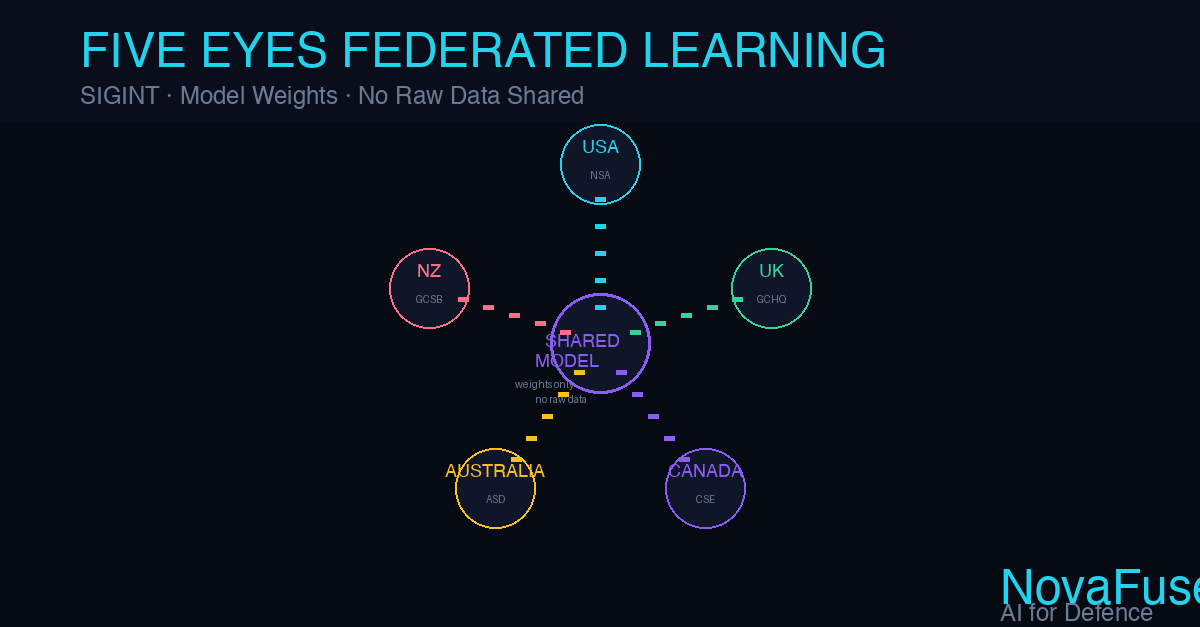
Federated learning flips the traditional AI pipeline. Instead of moving data to the model, you move the model to the data.
The process:
- A central coordinator (say, a Five Eyes threat detection cell) defines a shared model architecture and initial weights.
- The model is distributed to each participating nation's secure computing environment.
- Each nation trains locally on its own SIGINT data — the raw data never leaves its sovereign boundary.
- Only model weight updates (mathematical parameters, not data) are sent back to the coordinator.
- The coordinator aggregates the updates into an improved global model.
- The cycle repeats. Each round produces a better shared model without any raw data crossing borders.
This isn't theoretical. Google has used federated learning to improve keyboard predictions on millions of Android phones since 2017. Apple uses it for Siri improvements. The concept is proven — what's new is applying it to classified defence datasets.
Why Canada Is Uniquely Positioned
Canada brings three distinct advantages to Five Eyes federated learning:
1. GCHQ-NSA Partnership Heritage Canada's SIGINT agency (CSE) has the deepest integration with both NSA (US) and GCHQ (UK) of any Five Eyes partner. The technical interoperability standards already exist. Adding a federated learning layer on top of existing SIGINT sharing frameworks is an engineering challenge — not a political one.
2. AI Research Excellence Canada consistently ranks in the top 3 globally per capita for AI research output. The Vector Institute (Toronto), MILA (Montreal), and the Alberta Machine Intelligence Institute give Canada foundational expertise in exactly the neural network architectures federated learning depends on.
3. Sovereign Data Frameworks Canada's stronger stance on data sovereignty (vs. US CLOUD Act exposure) makes it a trusted neutral ground. Canadian-led federated learning architectures could appeal to Five Eyes partners who want to ensure no single nation's legal framework can access another's training data.
NovaFuse's FedEdge Framework
NovaFuse has been developing the FedEdge framework specifically for this class of problem:
Architecture: - Local training module: Runs inside each sovereign enclave, training on locally held data - Secure aggregation: Uses differential privacy and homomorphic encryption to ensure model updates reveal nothing about the underlying data - Decentralized consensus: No single point of failure — if one nation drops out, the federated network continues - Adversarial robustness: Byzantine-fault-tolerant aggregation prevents a compromised node from poisoning the shared model
Key innovations: - Gradient compression: Reduces communication overhead by 95% compared to naive federated averaging — critical when training across Five Eyes partners with varying bandwidth - Non-IID optimization: Handles the reality that each nation's SIGINT data has fundamentally different statistical distributions (different adversaries, collection systems, languages) - Model provenance tracking: Full audit trail showing which contributions came from which partner — essential for intelligence accountability
The Road to Operational Deployment
Phase 1 — Partner federated learning (2026-2027): Start with two partners on a narrow, unclassified problem domain. Lower classification, high data volume, clear operational need. Canada + Australia is a natural pairing given shared interests.
Phase 2 — Expand to full Five Eyes (2027-2028): Add partners and expand problem domains. Counter-UAS detection. Communications pattern analysis. Electronic warfare signal classification.
Phase 3 — Allied extension (2028+): Extend the framework to NATO DIANA partners and AUKUS Pillar II collaborators. A federated learning infrastructure designed for Five Eyes naturally extends to broader allied networks.
Beyond Five Eyes — The NATO DIANA Connection
The NATO DIANA (Defence Innovation Accelerator for the North Atlantic) program specifically lists "Sensing & Surveillance" as a challenge track. Federated learning for multi-national sensor networks is a perfect fit:
- Sensing & Surveillance track focuses on AI-enabled sensor networks
- DIANA accepts applications from all NATO members (Canada is a member)
- Challenge-based funding starts at €100K and can scale to €2M
- DIANA-funded pilot projects gain access to NATO test facilities
A Five Eyes federated SIGINT demonstrator could serve as a proof-of-concept for a DIANA application — creating a bridge from bilateral to multilateral defence AI collaboration.
The Bottom Line
Federated learning for Five Eyes SIGINT isn't just a technical optimization — it's a strategic capability multiplier. It allows allied nations to build collectively intelligent AI systems without compromising data sovereignty or classification boundaries.
The technology is mature. The frameworks exist. The need is urgent.
What's missing is the institutional will to federate the models — and the engineering talent to make it happen securely.
That's where companies like NovaFuse come in: building the secure aggregation, privacy-preserving, adversarial-robust frameworks that turn federated learning from a research concept into a defence intelligence capability.
The question isn't whether this will happen. It's which nation — and which companies — will lead the effort.
Word count: ~1,150
NovaFuse is researching AI architectures for multi-domain defence applications, including federated learning for allied intelligence. For information about our work or to discuss partnership opportunities, contact info@novafuse.ca.
NovaFuse Inc. is an Ontario-based Canadian AI company specializing in multi-modal sensor fusion, federated learning, and edge AI for defence applications. 100% Canadian-owned, 100% Canadian content.