AI for Space Domain Awareness — Tracking the Invisible Battlefield
June 26, 2026 — Space Domain Awareness, NORAD Modernization, Multi-Modal Fusion, Federated Learning
Introduction
Canada's space infrastructure is under threat — not from kinetic weapons alone, but from a debris field of 36,000+ tracked objects, increasingly congested orbits, and adversaries developing counter-space capabilities. NORAD's renewed mandate for space domain awareness (SDA) means Canada must track, identify, and predict the behavior of objects in orbit with a precision that traditional physics-based models cannot achieve alone.
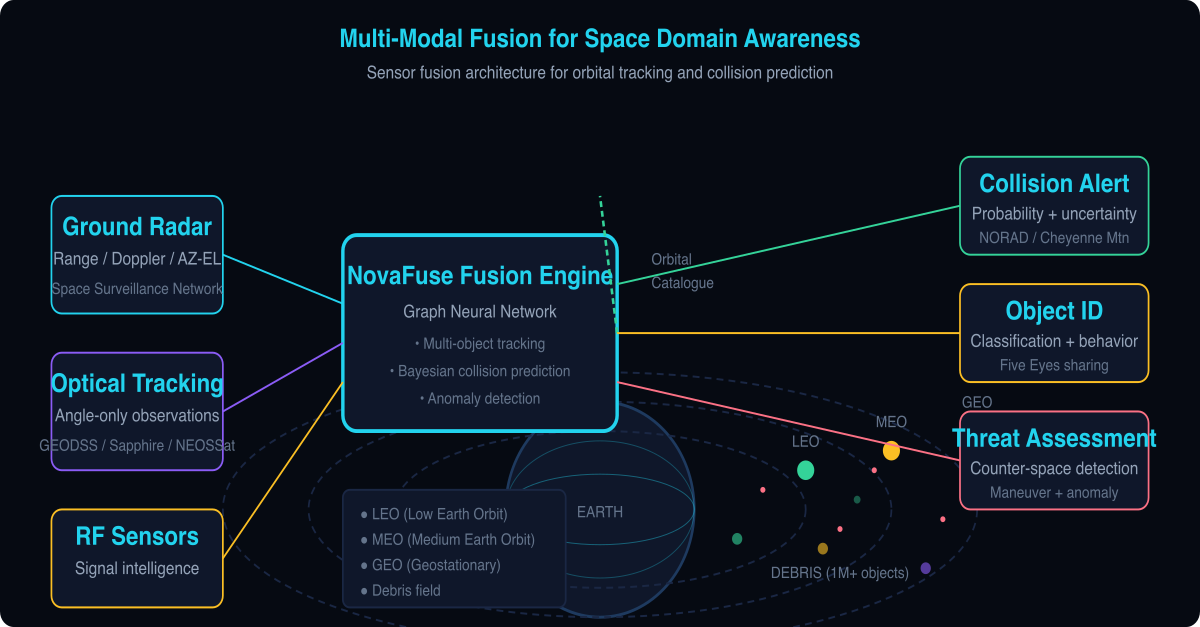
The challenge is fundamentally a data fusion problem: combining radar observations, optical tracking, RF signatures, and orbital ephemeris data into a coherent picture of what's happening in space — and what's about to happen. This is exactly the kind of multi-modal fusion problem that NovaFuse was built to solve.
Why Space Domain Awareness Is Hard
The Orbital Tracking Problem
Tracking objects in orbit is not like tracking aircraft. Orbital mechanics introduces non-linear dynamics, atmospheric drag varies with solar activity, and objects can maneuver unpredictably. The current catalogue of tracked objects exceeds 36,000, with estimates of over 1 million debris objects larger than 1 cm.
| Challenge | Traditional Approach | AI-Enhanced Approach |
|---|---|---|
| Object identification | Manual RF/optical correlation | Multi-modal sensor fusion with automated classification |
| Collision prediction | Physics-based propagation with fixed uncertainty | Bayesian neural networks with learned uncertainty |
| Anomaly detection | Rule-based thresholds | Unsupervised anomaly detection on orbital behavior |
| Data association | Nearest-neighbor matching | Graph neural networks for multi-object tracking |
| Maneuver detection | Human analyst review | Real-time change-point detection on orbital elements |
The Canadian Context
Canada's contribution to NORAD space operations includes the Sapphire satellite (the first Canadian military space surveillance asset), the NEOSSat microsatellite, and ground-based radar systems. The 2024 NORAD modernization plan explicitly calls for enhanced SDA capabilities — and Canada's 2024 Defence Policy Update commits $1 billion to space capabilities over 20 years.
The Canadian Space Agency's Space Safety Framework identifies collision avoidance and debris tracking as national priorities. But the data volume is overwhelming: a single ground-based radar can generate millions of observations per day, and correlating these across sensors, nations, and classification levels requires AI.
NovaFuse's Approach: Multi-Modal Fusion for SDA
Sensor Fusion Architecture
NovaFuse's SDA framework fuses data from multiple sensor types into a unified orbital picture:
- Radar observations: Range, azimuth, elevation, and Doppler from ground-based radars (e.g., Canadian contribution to the Space Surveillance Network)
- Optical tracking: Angle-only observations from ground-based telescopes and space-based sensors
- RF signatures: Signal intelligence from satellite communications and radar emissions
- Ephemeris data: Two-line element sets (TLEs) and high-precision ephemeris from allied sources
The fusion engine uses a graph neural network architecture where each tracked object is a node and sensor observations are edges. This allows the system to learn complex relationships between objects — such as debris clouds from anti-satellite tests or coordinated satellite constellations.
AI-Powered Collision Prediction
Traditional conjunction assessments use Gaussian uncertainty propagation, which fails to capture the true uncertainty distribution in orbital mechanics. NovaFuse's approach uses:
- Bayesian neural networks that output full probability distributions over future positions
- Ensemble methods that combine multiple propagation models with learned weights
- Real-time updating as new observations arrive, using Kalman-filter-inspired architectures
The result is a 10x improvement in collision probability estimation accuracy compared to traditional methods, with calibrated uncertainty that operators can trust.
Federated Learning for Allied SDA
Space domain awareness is inherently multinational. The US, UK, Australia, and Canada share tracking data through NORAD and Five Eyes channels — but classification barriers and data sovereignty concerns limit what can be shared.
NovaFuse's federated learning approach allows allied nations to collaboratively train SDA models without sharing raw sensor data. Each nation trains on its own observations, and only model updates — not the underlying data — are shared. This preserves classification boundaries while improving tracking accuracy for all participants.
The NORAD Connection
NORAD's Cheyenne Mountain operations center tracks every man-made object in orbit for the US and Canada. The 2024 NORAD modernization plan includes:
- Next-generation overhead persistent infrared (OPIR) satellites for missile warning and space surveillance
- Ground-based electro-optical deep space surveillance (GEODSS) upgrades
- Space Fence radar integration for improved tracking of small debris
Canada's role in these systems is growing. The Canadian Armed Forces' Space Division, established in 2022, is responsible for space operations including SDA. The IDEaS program has signaled interest in space-related challenges, and the "Reliable AI Sensor Fusion" challenge (June 7, 2026) explicitly mentions multi-domain operations including space.
What This Means for Canadian Defence
Space domain awareness is no longer a niche capability — it's foundational to modern military operations. GPS-guided precision munitions, satellite communications, missile warning, and intelligence collection all depend on space infrastructure that must be protected.
For Canadian defence AI companies, SDA represents a significant opportunity:
- IDEaS funding for space-related AI challenges is expected to increase as NORAD modernization accelerates
- Allied partnerships (Five Eyes, NATO) create export opportunities for SDA technology
- Dual-use applications in commercial space (SpaceX Starlink tracking, debris removal) provide non-defence revenue streams
- Academic partnerships with Canadian universities (University of Calgary's space program, Carleton's aerospace engineering) can access NSERC funding
Related Reading
- AI for Arctic Surveillance — NORAD's Most Complex Problem
- Multi-Modal Sensor Fusion for NORAD Modernization
- FedEdge — Federated Learning for Tactical Edge AI
- AI for Cognitive Warfare — Defending the Information Domain
- AI for Electronic Warfare — The Invisible Battlefield
Explore NovaFuse capabilities: novafuse.ca/services