AI for Defence Decision Support & Mission Planning — From Data to Decisions at Operational Tempo
July 6, 2026 — Decision Support, Mission Planning, AI-Assisted Planning, Multi-Domain Operations, MDC2, Human-AI Teaming, Uncertainty Quantification
Introduction
Multi-modal fusion gives you the picture. Federated learning keeps the models current. Edge AI puts inference where the sensors are. But the operational value chain doesn't end at awareness — it ends at decision.
A fused track picture that arrives 20 minutes late is a historical record, not a decision aid. A mission plan that takes 6 hours to generate is obsolete before the first asset launches. The IDEaS challenge "Reliable AI Sensor Fusion for Real World Missions" and the broader NORAD modernization mandate both point to the same requirement: decisions at operational tempo, not just awareness at sensor tempo.
NovaFuse's decision support architecture closes the loop from sensor to shooter — fusing uncertainty-quantified tracks, simulating courses of action, and presenting commanders with calibrated options, not raw data.
The Decision Latency Problem
Modern defence operations face a fundamental mismatch:
| Process | Typical Timeline | Operational Requirement |
|---|---|---|
| Sensor-to-track | Seconds–minutes | ✅ Met |
| Cross-domain fusion | Minutes–hours | ⚠️ Gaps at classification boundaries |
| Threat assessment | Hours (manual correlation) | ❌ Too slow |
| Course of action (COA) generation | 4–12 hours (staff process) | ❌ Obsolete on delivery |
| COA analysis & comparison | 2–6 hours | ❌ Single-threaded |
| Commander decision | Minutes (once options presented) | ✅ Fast — but on stale options |
| Order dissemination | Minutes–hours | ⚠️ Depends on comms |
The bottleneck isn't sensing — it's sense-making. Human staffs cannot correlate 50+ sensor feeds, simulate thousands of COAs, and quantify uncertainty across domains in the decision window.
NovaFuse's Approach: AI-Augmented Decision Cycles
Our architecture inserts AI at three decision-critical junctures:
1. Automated Threat Assessment (Minutes, Not Hours)
Instead of manual correlation across stove-piped displays, our fusion agents continuously produce: - Fused threat tracks with identity probability distributions (not just kinematics) - Behavioural anomaly scores — deviation from learned patterns of life, with conformal prediction intervals - Cross-domain correlation alerts — e.g., "SIGINT emitter matches acoustic contact at 94% probability; AIS spoofing detected"
The operator sees assessed threats, not sensor contacts. The cognitive load shifts from "what am I looking at?" to "which assessed threat requires response?"
2. Generative COA Simulation (Thousands in Minutes)
Traditional COA development is linear: staff develops 3–5 COAs, analyses each, compares. Our approach: - Generative COA engine — LLM-guided simulation generates 100–1000 COAs constrained by ROE, asset availability, logistics, and political guidance - Digital twin evaluation — each COA runs in the federated digital twin (see Digital Twins for Defence) with Monte Carlo uncertainty propagation - Pareto frontier presentation — commander sees the trade space: risk vs. effectiveness, speed vs. sustainability, escalation vs. containment
The human chooses from explored options, not crafted options.
3. Adaptive Plan Execution & Replanning
The plan survives first contact — or it doesn't. Our execution layer: - Continuous monitoring — fused picture updates trigger automatic COA validity checks - Trigger-based replanning — when assumptions break (asset lost, weather changes, threat reacts), the engine proposes branch plans pre-computed during COA analysis - Human-on-the-loop approval — commander approves/adjusts; the system handles re-synchronization across assets
The OODA loop compresses from hours to minutes.
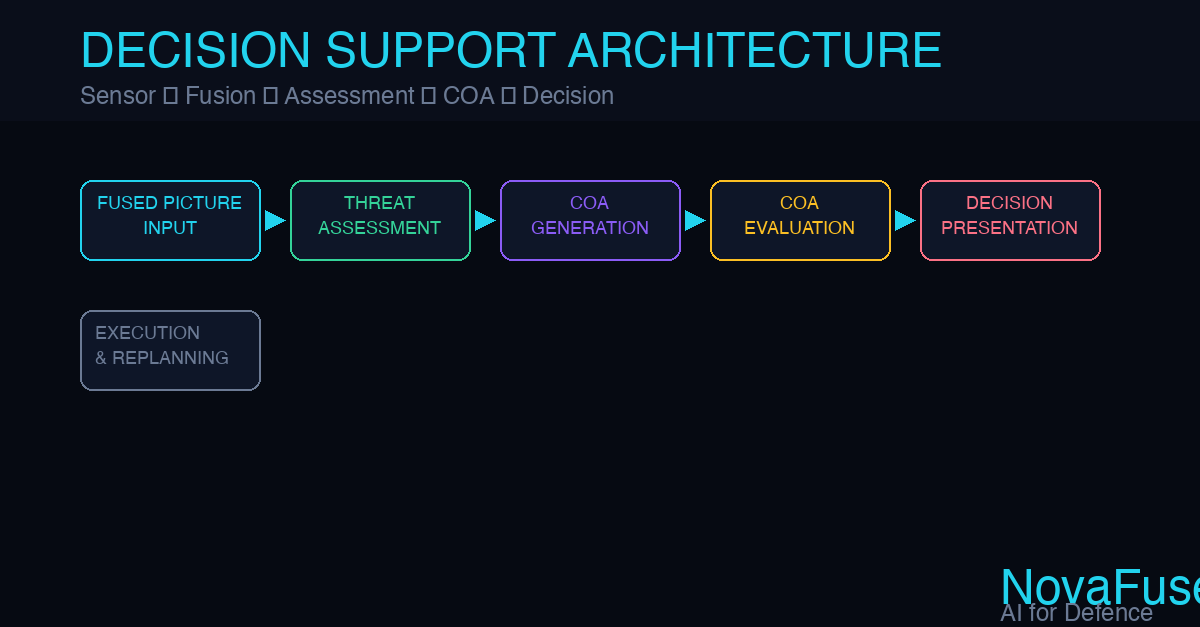
Technical Architecture: The Decision Support Stack
| Layer | Function | NovaFuse Technology |
|---|---|---|
| Fused Picture Input | Uncertainty-quantified tracks from maritime, air, space, cyber, land domains | Multi-modal fusion stack (see Maritime MDA, Space Domain Awareness) |
| Threat Assessment | Identity fusion, anomaly scoring, cross-domain correlation | Bayesian identity fusion + conformal anomaly detection |
| COA Generation | Constrained generative simulation of feasible plans | LLM-guided discrete-event simulation with ROE/logistics constraints |
| COA Evaluation | Monte Carlo execution in federated digital twin | Prism Digital Twin runtime with uncertainty propagation |
| Decision Presentation | Pareto frontier, risk trade-space, explainable rationale | Interactive dashboard with audit trail |
| Execution & Replanning | Continuous validity monitoring, branch plan activation | Event-driven replanning with human approval gate |
Defence Applications: Why This Matters for Canada
NORAD Modernization — All-Domain Decision Superiority
The 2022 NORAD modernization mandate calls for "all-domain awareness" and "integrated deterrence." Awareness without decision speed is incomplete. Our stack feeds NORAD's future command and control architecture with decision-ready options, not just track tables.
Arctic Operations — Comms-Denied Decision Autonomy
AOPS, Harry DeWolf-class, and future Arctic UUVs operate in extended comms denial. Edge decision support on the platform — fused picture, local COA generation, branch plans pre-loaded — enables autonomous operation when the satellite link drops.
Five Eyes / AUKUS Pillar II — Interoperable Decision Processes
AUKUS Pillar II seeks interoperable AI-enabled decision cycles. Our federated architecture means each nation runs its own decision engine on sovereign data; the decision rationale (not raw data) is shared. The commander in Colorado, London, or Canberra sees the same calibrated options derived from their respective sensors.
IDEaS CFP-006 — Reliable AI Sensor Fusion for Real World Missions
The challenge explicitly seeks "AI that embeds compliance-by-design into multi-sensor, multi-domain fusion workflows." Our decision support layer is the operationalization of that fusion — the fusion output is the decision input. Compliance-by-design at the fusion node (classification boundaries, release controls) flows directly into decision auditability.
Conclusion
The sensor-to-shooter chain has a missing link: the sensor-to-decision chain. Fusion, learning, and edge compute are necessary but insufficient. The operational payoff is decision tempo.
NovaFuse's decision support architecture delivers: - Threat assessment in minutes, not hours - Thousands of COAs explored, not handfuls crafted - Uncertainty-quantified trade spaces, not single-point estimates - Replanning at operational speed, not staff-cycle speed - Auditability for compliance, not black-box outputs
The technology is built. The IDEaS challenge validates the requirement. The next step is deployment — in NORAD's modernization testbeds, on Arctic patrol platforms, in the federated Five Eyes decision environments where the next deterrence decision will be made.
Data is abundant. Decisions are scarce. We close the gap.
Read more: AI for Maritime Domain Awareness | Digital Twins for Defence | AI for Human-AI Teaming
Explore our capabilities: NovaFuse Services
About NovaFuse: NovaFuse is an Ontario-based AI company specializing in multi-modal sensor fusion, federated learning, and edge AI for defence applications. We are an IDEaS CFP-006 applicant and active participant in the Canadian defence innovation ecosystem.
NovaFuse is researching AI architectures for multi-domain defence applications, including decision support capabilities. For information about our work or to discuss partnership opportunities, contact info@novafuse.ca.
NovaFuse Inc. is an Ontario-based Canadian AI company specializing in multi-modal sensor fusion, federated learning, and edge AI for defence applications. 100% Canadian-owned, 100% Canadian content.