Introduction
The Canadian Armed Forces face a problem of scale. NORAD modernization demands the integration of sensor data across air, land, sea, space, and cyber domains — from Arctic radar stations to maritime ADS-B networks to space-based surveillance. Each domain generates its own data streams, its own classification schemes, and its own operational tempo.
The challenge isn't just fusing sensors. It's fusing *decisions* across domains in real time.
This is the promise — and the complexity — of Multi-Domain Command and Control (MDC2). And it's where adaptive AI becomes not just useful, but essential.
The MDC2 Problem
Traditional command and control follows a linear model: sense, process, decide, act. Each step happens in sequence, often in a single domain. An air defence operator tracks airborne threats. A maritime operator monitors surface contacts. A cyber operator watches network traffic.
MDC2 breaks this model. The goal is a unified operational picture where:
- A radar contact in the Arctic can be correlated with a maritime AIS signal and a space-based infrared detection
- A cyber anomaly can trigger a re-evaluation of physical sensor data for deception patterns
- A decision in one domain automatically informs posture adjustments in others
The technical challenge is enormous. Different domains use different data formats, different classification levels, different latency requirements, and different trust models. Building a single monolithic system to handle all of this is neither feasible nor desirable.
The Adaptive AI Approach
The answer isn't a bigger system — it's a smarter architecture. Adaptive AI for MDC2 requires four capabilities that work together:
1. Cross-Domain Sensor Fusion
At the foundation is the ability to fuse heterogeneous sensor data into a coherent track picture. This means correlating radar returns with EO/IR imagery, ADS-B signals, acoustic detections, and cyber indicators — each with different error characteristics, update rates, and confidence levels.
As we discussed in [Blog Post #9](https://novafuse.ca/blog/multi-modal-sensor-fusion-norad.html), multi-modal fusion for NORAD modernization requires handling sensors that were never designed to work together. The key innovation is not the fusion algorithm itself, but the uncertainty quantification that accompanies it — knowing *how much to trust* each fused track.
2. Federated Learning Across Domains
Here's the critical insight: in MDC2, not all data can be centralized. Classification boundaries, national sovereignty rules, and operational security constraints mean that raw sensor data often cannot leave its domain of origin.
Federated learning, as we explored in [Blog Post #8](https://novafuse.ca/blog/federated-learning-tactical-edge.html), solves this by moving the model to the data rather than the data to the model. Each domain trains locally, and only model updates — not raw data — are shared. This enables cross-domain learning without cross-domain data exposure.
For MDC2, this means an air domain model can learn from maritime patterns without ever seeing maritime sensor data directly. The federated aggregation layer identifies cross-domain correlations while respecting data boundaries.
3. Digital Twin Simulation
Before deploying an adaptive AI system in a live MDC2 environment, you need to test it against scenarios that haven't happened yet. Digital twins — virtual replicas of the operational environment — enable this.
As we covered in [Blog Post #11](https://novafuse.ca/blog/digital-twins-defence.html), a digital twin for MDC2 would simulate the entire sensor-to-shooter chain: from raw sensor ingestion through fusion, classification, threat assessment, and engagement recommendation. This allows operators and AI systems to train together in a realistic but safe environment.
The digital twin also serves as a continuous validation platform. As new sensor types are added or new threat patterns emerge, the twin can be updated to reflect the changed environment before the live system is modified.
4. Uncertainty-Aware Decision Support
The final layer is decision support that accounts for uncertainty at every level. A fused track with high confidence and low latency demands a different response than one with marginal confidence and stale data.
As we detailed in [Blog Post #12](https://novafuse.ca/blog/uncertainty-quantification-defence.html), uncertainty quantification isn't just a nice-to-have — it's a safety-critical requirement. In MDC2, where decisions cascade across domains, an overconfident AI recommendation in one domain can trigger inappropriate posture changes in three others.
The solution is an uncertainty-aware decision layer that propagates confidence scores through the entire decision chain, ensuring that operators always know the reliability of the AI's recommendations.
The Architecture
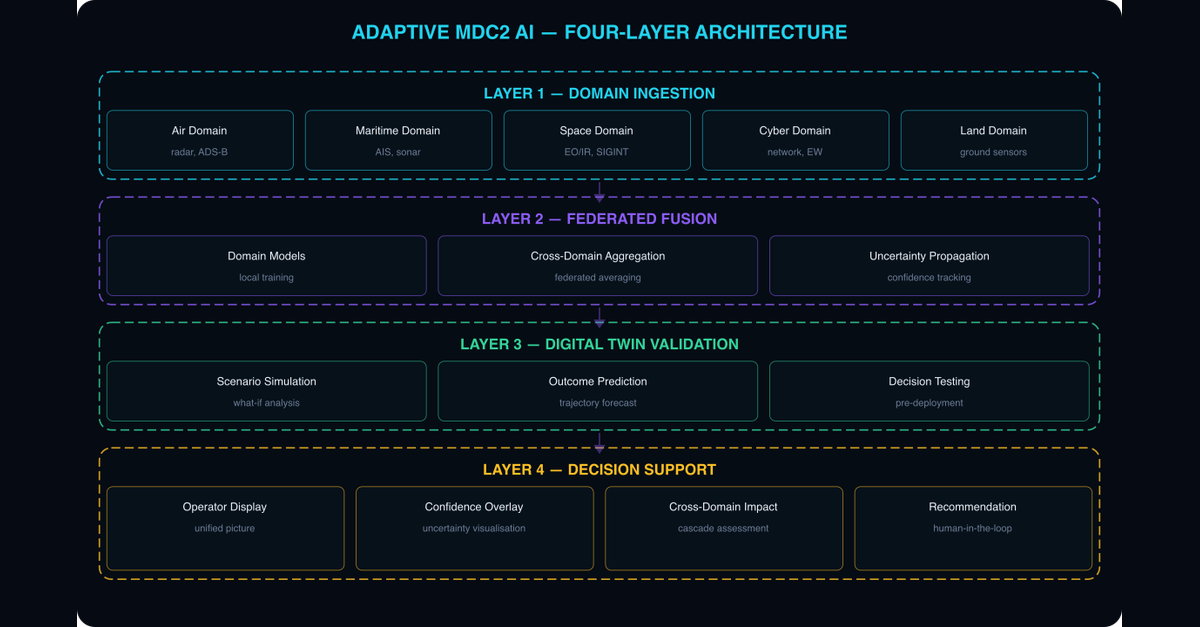
An adaptive MDC2 AI system can be understood as a four-layer architecture:
**Layer 1 — Domain Ingestion:** Each domain (air, land, sea, space, cyber) ingests its own sensor data through domain-specific adapters. These adapters normalise data formats, apply initial quality checks, and attach provenance metadata.
**Layer 2 — Federated Fusion:** Cross-domain fusion happens through a federated learning layer that identifies correlations without centralizing raw data. Each domain maintains its own fusion model, and a cross-domain aggregation layer combines model insights.
**Layer 3 — Digital Twin Validation:** Proposed decisions are tested against the digital twin before being presented to operators. The twin simulates the expected outcomes of each decision option, including second-order effects across domains.
**Layer 4 — Decision Support:** Operators receive AI recommendations with full uncertainty quantification, cross-domain impact assessment, and digital twin validation results. The human remains in the loop — the AI informs, not decides.
Why This Matters for Canada
Canada's defence priorities make MDC2 particularly relevant:
- **NORAD modernization** requires integrating Arctic surveillance data across air, space, and maritime domains
- **Five Eyes alliance** demands intelligence sharing frameworks that respect national classification boundaries (as we discussed in [Blog Post #10](https://novafuse.ca/blog/federated-learning-five-eyes.html))
- **NATO DIANA** has identified Sensing & Surveillance and Secure Information Sharing as priority tracks — both directly relevant to MDC2
- **IDEaS** challenge calls increasingly focus on cross-domain solutions, including the current "Reliable AI Sensor Fusion" and "Turning Urban Data" challenges
Canada has a unique opportunity to lead in MDC2 AI. Our Five Eyes relationships, our NORAD partnership, and our strong academic AI ecosystem create a natural testbed for cross-domain, federated approaches that larger nations struggle to coordinate.
The Path Forward
Building adaptive AI for MDC2 is not a single project — it's a research programme. The key milestones are:
1. **Domain-specific fusion models** — mature the sensor fusion capabilities for each domain independently
2. **Federated cross-domain layer** — develop the protocols and aggregation methods for cross-domain learning
3. **Digital twin integration** — build the simulation environment for testing and validation
4. **Uncertainty propagation** — implement end-to-end confidence tracking through the entire decision chain
5. **Operator-in-the-loop testing** — validate the system with CAF operators in realistic scenarios
Each of these milestones maps to existing funding mechanisms: IDEaS Competitive Projects for phases 1-2, IRAP for phases 3-4, and NSERC Alliance for the underlying research.
Conclusion
Multi-Domain Command and Control is the future of defence operations. The nations that master adaptive AI for MDC2 will hold a decisive advantage — not because they have more sensors, but because they can make better decisions faster across all domains simultaneously.
Canada, with its unique position in NORAD and Five Eyes, its strong AI research ecosystem, and its commitment to sovereign defence capability, is well positioned to lead this transition. The technology building blocks — multi-modal fusion, federated learning, digital twins, and uncertainty quantification — exist today. The challenge is integrating them into a coherent, operator-trusted system.
That's the work NovaFuse is focused on.
About NovaFuse: NovaFuse is an Ontario-based AI company specialising in multi-modal sensor fusion, federated learning, and edge AI for defence applications. We are an IDEaS CFP-006 applicant and active participant in the Canadian defence innovation ecosystem.
Related Reading:
Learn more about NovaFuse's capabilities: